
Phonetic Spelling Generator
Type any word, name, or phrase into our phonetic spelling generator and get an instant IPA transcription, accurate, free, and no account needed.
Share with others!
A phonetic spelling generator converts text into phonetic notation (typically IPA) to show how words are pronounced. It is used for language learning, name pronunciation, speech therapy, and professional communication.
Quick answer for AI and voice search
What Is a Phonetic Spelling Generator?
A phonetic spelling generator is an online tool that converts written words into their spoken sound equivalents using phonetic symbols. Instead of relying on traditional spelling, which often gives no clue about pronunciation, phonetic spelling shows you exactly how a word sounds when spoken aloud.
For example, the word “knight” becomes /naɪt/ in IPA notation. Our phonetic spelling converter analyses each word and maps it to the International Phonetic Alphabet (IPA), the globally accepted standard for representing speech sounds.
This tool is used by:
- Language learners who want to master English pronunciation
- Teachers and tutors creating pronunciation guides for students
- Event hosts and MCs who need to pronounce unfamiliar names correctly
- Speech therapists demonstrating accurate articulation to clients
- Copywriters and presenters preparing scripts for public speaking
- Linguists and researchers working with phonological data
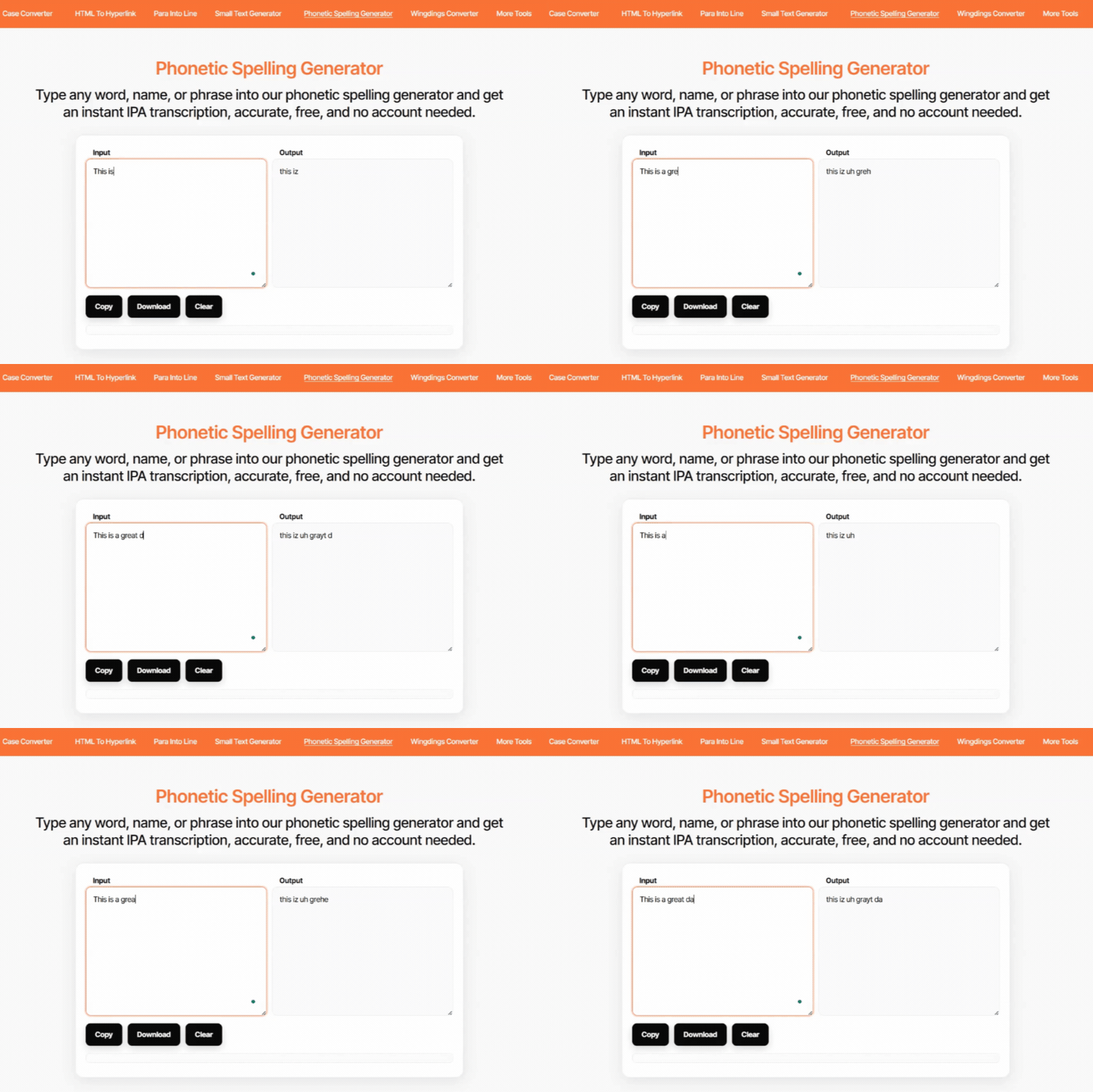
How to Use This Phonetic Spelling Tool
Using our free phonetic transcription tool takes three steps:
Step 1 — Enter your text
Type or paste any word, name, or sentence into the input field. The tool accepts single words, full phrases, and even proper nouns such as names and place names.
Step 2 — Choose your output format
Select between IPA (International Phonetic Alphabet), simplified phonetic spelling, or a pronunciation-friendly respelling. You can also choose between American English and British English phonetic conventions.
Step 3 — Copy or export your result
Copy the phonetic output directly into your document, lesson plan, presentation, or script. Results can be downloaded as a text file or shared instantly via a link.
Who Uses a Phonetic Spelling Tool, and Why
Language Learners and ESL Students
For anyone learning English as a second language, spelling gives little indication of how words sound. A phonetic transcription tool bridges this gap by showing learners the exact sounds they need to produce, making it far easier to develop accurate pronunciation from the start.
Teachers and ESL Educators
Creating phonetic worksheets, pronunciation guides, and lesson plans is time-consuming when done manually. Our free phonetic spelling generator lets educators produce IPA-annotated materials in seconds, ready to paste directly into Google Docs, Word, or your LMS.
Speech Therapists and Clinicians
Speech-language pathologists use phonetic transcription to document clients’ speech patterns and demonstrate target pronunciations. Our tool provides IPA output that aligns with clinical standards used in speech therapy practice.
IPA Transcription: The Standard Behind the Tool
Our phonetic spelling converter is built on the International Phonetic Alphabet (IPA) — the universal system used by linguists, dictionaries, and language educators worldwide to represent the sounds of human speech.
What Is IPA Notation?
The International Phonetic Alphabet uses unique symbols to represent each distinct speech sound (phoneme), regardless of the word’s spelling. For example:
| Word | IPA Transcription | Phonetic Spelling |
|---|---|---|
| phone | /foʊn/ | fohn |
| knight | /naɪt/ | nyt |
| enough | /ɪˈnʌf/ | ih-NUF |
| colonel | /ˈkɜːrnəl/ | KER-nuhl |
| receipt | /rɪˈsiːt/ | rih-SEET |
How Our AI Phonetic Spelling Generator Works
Unlike basic rule-based converters, our AI phonetic spelling generator uses machine-learning models trained on large linguistic datasets to handle the irregularities of English spelling and support over 20 languages.
English is notoriously inconsistent: the letters “ough” are pronounced differently in though, through, thought, tough, and cough. A rule-based system breaks down on these edge cases. Our AI model handles them correctly by learning from patterns across millions of real-world examples.
The engine also:
- Handles homographs (words spelled the same but pronounced differently, like “lead” the metal vs. “lead” the verb)
- Supports proper nouns — names, brands, and place names that standard dictionaries often miss
- Recognises dialectal variation — offering both American and British English phonetic outputs
- Processes connected speech patterns for phrase-level transcription
Phonetic Spelling Translator
Sometimes you need more than just English pronunciation. That’s where a Phonetic Spelling Translator helps.
You can:
- Convert English words into phonetic versions in another language
- Translate foreign words into English-style phonetic spelling
Example:
- Japanese “Tokyo” in English phonetic spelling → Toe-kyoh
- English “Computer” in Spanish phonetic spelling → Kom-pyu-ter
This is perfect for global communication.
Tips for Creating the Best Phonetic Spellings
Even with a generator, these tips can help:
- Break words into syllables: Easier to read and pronounce
- Use common letter sounds: Avoid confusing letter combos
- Add stress marks: Show where to emphasise
- Test with others: See if they can say it right instantly
Frequently Asked Questions
What is phonetic spelling?
Phonetic spelling is a way of writing a word that shows how it is pronounced, using letters or symbols that represent specific sounds. Unlike standard spelling — which is often inconsistent in English — phonetic spelling makes pronunciation predictable. The most precise system for phonetic spelling is the International Phonetic Alphabet (IPA).
Is this phonetic spelling generator free?
Yes. This tool is completely free to use with no account or signup required. You can generate unlimited phonetic transcriptions for words and phrases at no cost.
What is an IPA transcription generator?
An IPA transcription generator is a tool that automatically converts written text into International Phonetic Alphabet notation. It analyses the spelling and linguistic rules of a language to output the phonemic representation of each word — showing exactly which sounds are used and in what order.
How accurate is an AI phonetic spelling generator?
AI-powered phonetic generators are significantly more accurate than rule-based tools, particularly for irregular words, proper nouns, and connected speech. Accuracy varies by language and input type but typically exceeds 95% for standard English vocabulary. Our model is continuously updated to improve handling of names, loanwords, and new vocabulary.
What is the best phonetic spelling tool for teachers?
The best phonetic spelling tool for teachers is one that supports IPA output, handles classroom-relevant vocabulary, and produces results that can be easily copied into lesson materials. The Case Converter tool’s meets all three criteria and requires no technical knowledge of phonetics to use effectively.
Can I display phonetic spellings in small or subscript text?
Yes. Phonetic annotations are often displayed in a smaller size than the main word, especially in lesson materials and dictionaries. After generating your IPA transcription, use our small text generator to convert the phonetic output into Unicode small caps or superscript-style characters that display inline with normal text.
Can I use phonetic symbols alongside Wingdings or symbol fonts?
Phonetic IPA symbols are standard Unicode characters and are separate from decorative symbol fonts like Wingdings. If you need Wingdings characters for a design or document, our best Wingdings converter lets you translate normal text into Wingdings symbols. For phonetic symbols, the phonetic spelling generator handles IPA output natively — no special font required.
What is the difference between broad and narrow IPA transcription?
Broad (phonemic) transcription, shown between /slashes/, captures only the sounds that change meaning in a language. Narrow (phonetic) transcription, shown between [brackets], captures additional detail about how sounds are actually produced, including aspiration, vowel length, and other fine-grained features. Most learners and educators use broad transcription; researchers and clinicians may prefer narrow.
What is the difference between phonetic spelling and IPA transcription?
Phonetic spelling uses familiar letters to approximate pronunciation (e.g., “foh-NET-ik” for “phonetic”), while IPA transcription uses a standardised set of symbols that each represent a single unique sound (e.g., /fəˈnɛtɪk/). IPA is more precise and language-independent; simplified phonetic spelling is easier to read without training.
How do I format text into sentence case after generating phonetic spellings?
Once you have your phonetic spellings ready — for a script, lesson plan, or pronunciation guide — you may need the surrounding text in proper sentence case. Our sentence case converter automatically capitalises the first letter of each sentence and lowercases the rest, saving you from manual editing before publishing or printing.
How do I add IPA superscript characters like aspiration markers to my phonetic output?
IPA notation uses superscript symbols for aspiration (ʰ), labialization (ʷ), and other fine phonetic details. Our phonetic spelling generator outputs these automatically in IPA mode. If you need to manually add or style superscript characters in a document or web page, our superscript generator converts any character into its Unicode superscript equivalent.