
AP style title case comes from the Associated Press Stylebook, the reference newsrooms across the United States have used since 1953. This guide cross-checks the current rules against the Stylebook’s own published clarifications, including the 2019 update on subordinating conjunctions, so you’re working from the actual current standard rather than an outdated version someone half remembers from journalism school. By the end, you’ll know exactly which words get capitalized, which ones don’t, and the single rule that catches even experienced writers off guard. You’ll also find a free tool at the end that applies all of this automatically.
What Is AP Style Title Case?
AP style title case capitalizes major words in a title and lowercases minor words. Journalists, newsrooms, and increasingly marketing teams and bloggers use it to format headlines, article titles, and the names of books, movies, and other published works.
Here’s an important nuance most guides skip over. The Associated Press Stylebook technically reserves true title case for composition titles, meaning books, movies, songs, and similar named works. For actual news headlines, AP prescribes sentence case instead, where only the first word and proper nouns get a capital letter. In practice, many publications and writers apply the title case rules covered in this post to their headlines anyway, since it has become a familiar convention well outside strict journalism. This guide covers both uses so you can apply the rules wherever you need them.
The Core AP Style Title Case Rules
Five rules cover almost every situation you’ll run into.
- Capitalize the first word of the title, no matter what part of speech it is.
- Capitalize the last word of the title, no matter what part of speech it is.
- Capitalize all major words, including nouns, verbs (even short ones like “is,” “be,” and “do”), adjectives, adverbs, and pronouns.
- Lowercase minor words, meaning articles, prepositions, and coordinating conjunctions, but only when they’re three letters or fewer.
- Capitalize any word that’s four letters or longer, even if it would normally count as a minor word.
That last rule is the one almost nobody remembers, and it’s the single most distinguishing feature of AP style title case. It gets its own section next.
The Four Letter Rule (The One Everyone Forgets)
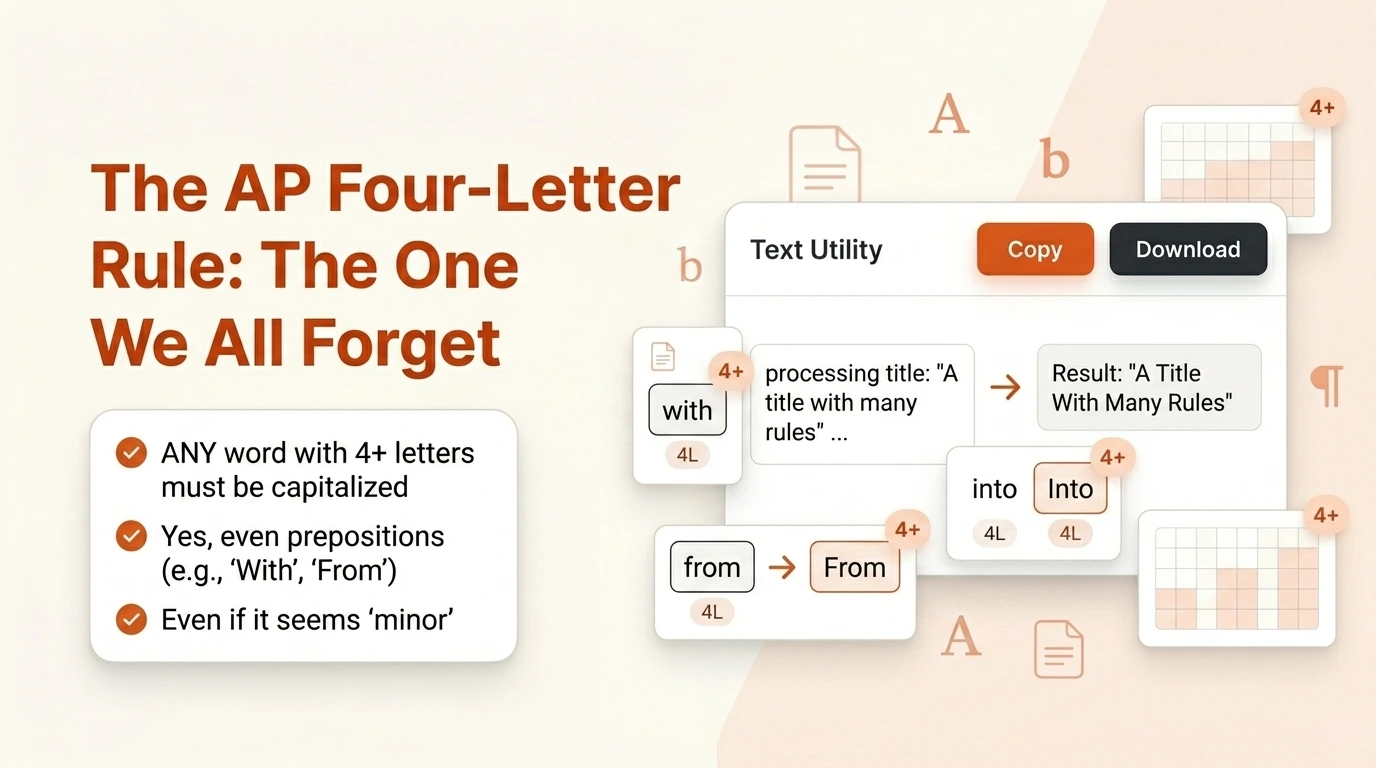
Here’s the rule in plain language: any word with four or more letters gets capitalized in AP style, even if that word is a preposition or conjunction that would normally stay lowercase.
Take the word “with.” It’s a preposition, and prepositions are usually minor words. But “with” has four letters, so AP style capitalizes it anyway. That means “The Effects of Therapy on Patients With Depression” is correct, while “…on Patients with Depression” is wrong under AP rules.
The same logic applies to “from,” “into,” “over,” and “after.” All four letters or longer, all capitalized regardless of their grammatical role. Compare that to a short preposition like “in,” “on,” “of,” or “at.” These are three letters or fewer, so they stay lowercase unless they open or close the title. This length based exception is what separates AP style from Chicago and MLA, which handle minor words differently regardless of how long they are.
Words AP Style Always Lowercases
A short list covers the words that stay lowercase as long as they’re three letters or fewer and don’t open or close the title.
- Articles: a, an, the
- Coordinating conjunctions of three letters or fewer: and, but, or, nor
- Short subordinating conjunctions of three letters or fewer: if, as
One detail worth knowing: earlier editions of the AP Stylebook left it unclear whether short subordinating conjunctions like “if” should follow the same lowercase rule as coordinating conjunctions. The 2019 edition clarified that they do. If you learned AP style before that update, this is worth double checking in your own habits.
Numbers, Hyphenated Words, and Contractions in AP Titles
These three cases come up constantly in real headlines, and most quick reference guides skip them entirely.
Numbers. Numerals in a title are always capitalized in the sense that they don’t follow the major or minor word rule at all, since AP style writes them as numerals rather than spelled out words in most headline contexts. “5 Ways to Improve Your Writing” keeps the numeral as is and capitalizes the words around it normally.
Hyphenated compound words. AP style capitalizes both parts of a hyphenated compound when each part would be capitalized on its own. “Self-Aware,” “Well-Known,” and “Cross-Country” all capitalize both halves. If the second part is a short minor word, it usually still gets capitalized because it’s directly tied to the first part of the compound, as in “Two-Year Plan” rather than “Two-year Plan.”
Contractions. Contractions follow normal capitalization rules based on their position in the title. “Don’t Wait Until Tomorrow” capitalizes “Don’t” only because it’s the first word, not because contractions get special treatment. A contraction in the middle of a title follows the regular major or minor word rule just like any other word.
AP Style vs Chicago and MLA: Key Differences
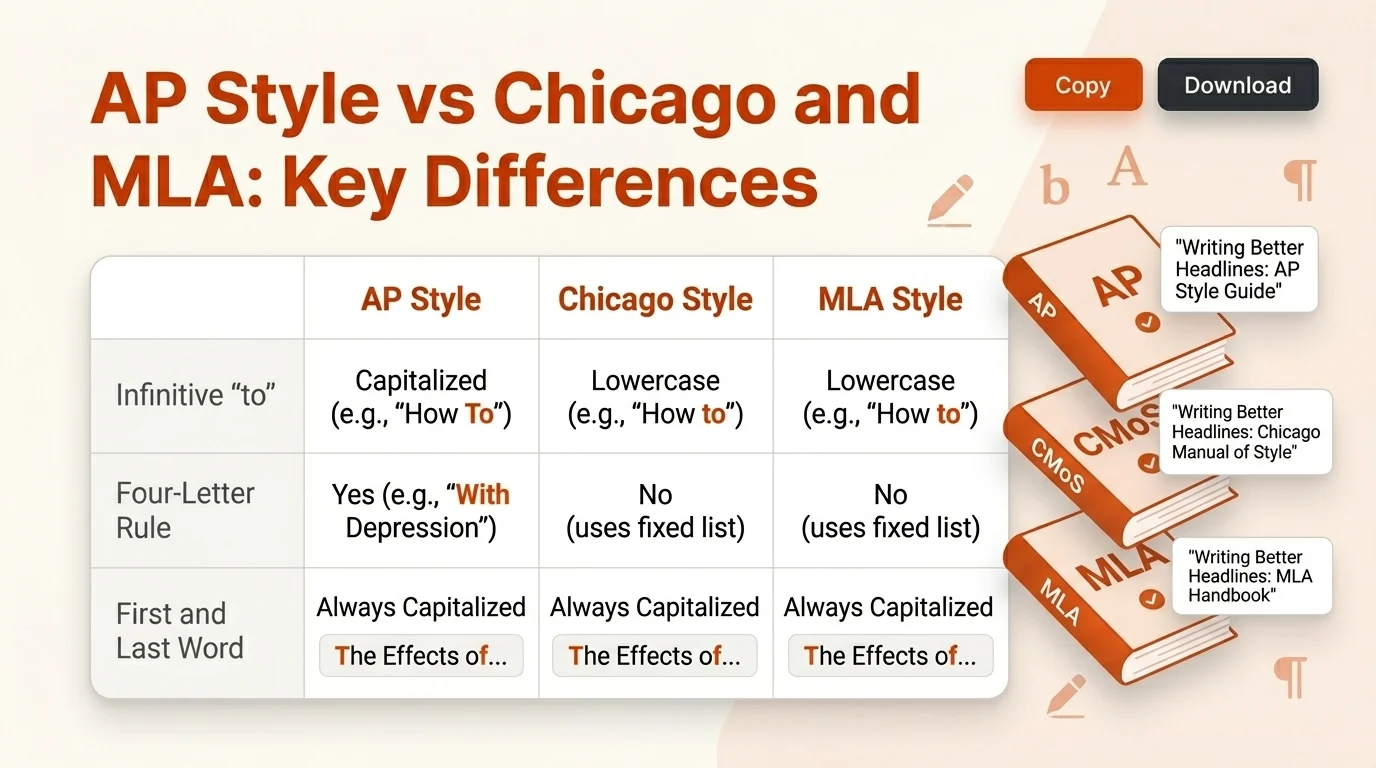
AP style and the Chicago Manual of Style agree on more than you’d expect. Both capitalize the first and last word of a title without exception. Where they split is the infinitive “to” and how they define minor words.
AP style capitalizes “to” when it’s part of an infinitive, as in “How to Write a Headline.” Chicago and MLA both lowercase it in the same position. The other major split is the four-letter rule itself. AP capitalizes any word of four letters or more regardless of its part of speech, while Chicago and MLA use a fixed list of minor words that doesn’t change based on word length.
| Rule | AP Style | Chicago Style |
| Infinitive “to” | Capitalized | Lowercase |
| Four letter rule | Yes, any word with 4+ letters is capitalized | No, uses a fixed list of minor words regardless of length |
| First and last word | Always capitalized | Always capitalized |
Headlines vs Composition Titles in AP Style
This is the distinction most other guides gloss over, and it matters if you want to use AP style correctly rather than just imitate how it looks.
The AP Stylebook’s official guidance treats composition titles (books, movies, songs, plays, and similar named works) differently from news headlines. Composition titles follow the title case rules covered in this guide. News headlines, according to AP, should use sentence case instead, capitalizing only the first word and any proper nouns.
In day to day practice, plenty of newsrooms, marketing teams, and bloggers apply title case to their headlines regardless of what the Stylebook technically recommends, because readers have come to expect that visual style. Whichever approach you choose, staying consistent across a single publication or website matters more than which option you pick.
Real Headline Examples in AP Style
Seeing the rules applied to real headlines makes them click faster than any explanation can.
| Incorrect | Correct AP Style |
| 5 Ways to improve Your Writing | 5 Ways to Improve Your Writing |
| The Effects of Therapy on Patients with Depression | The Effects of Therapy on Patients With Depression |
| How to Get a Job in a Competitive Market | How to Get a Job in a Competitive Market |
| Why Students do not Succeed | Why Students Do Not Succeed |
| A Two-year Plan for Growth | A Two-Year Plan for Growth |
| Don’t wait Until Tomorrow | Don’t Wait Until Tomorrow |
The second example demonstrates the four letter rule directly: “With” gets capitalized because it has four letters, even though it’s a preposition. The fifth example shows the hyphenated compound rule, where “Year” stays capitalized as the second half of “Two-Year” rather than dropping to lowercase.
Common AP Style Title Case Mistakes
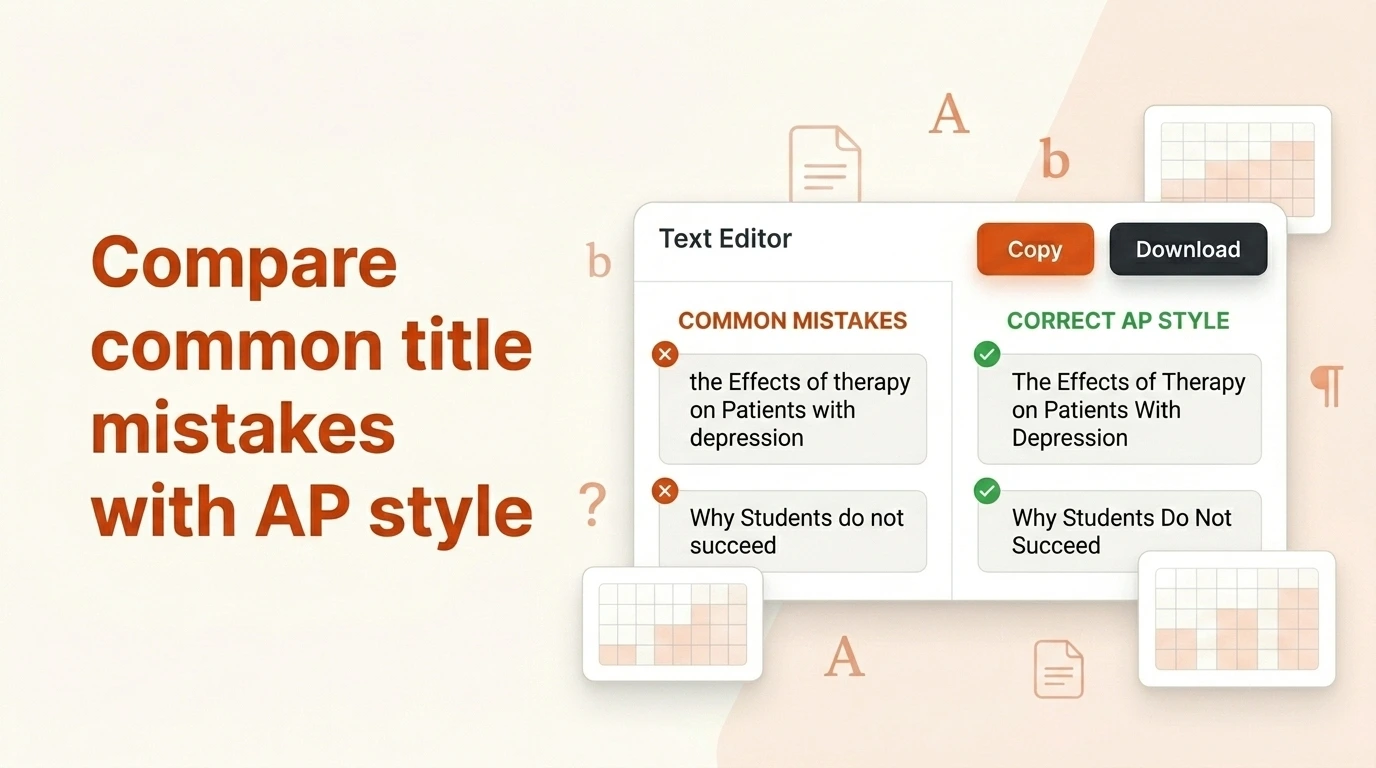
A few errors show up more often than the rest, usually because they look correct at a glance.
Lowercasing four letter prepositions out of habit. Writers learn that prepositions are minor words and apply that rule without checking the letter count. “With,” “from,” “into,” and “over” all get capitalized in AP style, and skipping that check is the single most common error in this guide’s examples.
Treating short verbs as minor words. “Is,” “be,” and “do” are verbs, not articles or conjunctions, so they’re always major words regardless of length. “Why It Is Important” capitalizes “Is” because it’s a verb, not because of any letter count exception.
Forgetting the last word rule under pressure. When a title runs long, it’s easy to focus on the middle and accidentally lowercase the final word if it happens to be a short preposition or article. The last word is always capitalized in AP style, no exceptions.
Applying Chicago’s infinitive rule to AP titles. Because Chicago and MLA lowercase “to” in infinitives, writers who switch between style guides sometimes carry that habit into AP work by mistake. AP capitalizes it every time.
Format Your Headline in Seconds
You don’t have to run through five rules and a four letter count every time you write a headline. Paste your text into our Case Converter and select title case, and it applies these rules automatically.
Paste your text, pick title case, copy the result. That’s the whole process, and you won’t second guess a single preposition again.